Beschwerden
Medical cannabis for Tourette’s
Hinweis: Vom Arzt verschriebenes und Apotheker hergestelltes medizinisches Cannabis ist ein verschreibungspflichtiges Arzneimittel.
Die Inhalte dieser Website dienen ausschließlich der allgemeinen Information und ersetzen keine individuelle medizinische Beratung, Diagnose oder Behandlung. Bei gesundheitlichen Beschwerden oder Fragen zur Therapie wenden Sie sich bitte an Ihre behandelnde Ärztin oder Ihren behandelnden Arzt.
Reducing tic frequency and improving quality of life
Medical cannabis for Tourette’s can be a treatment option when behavioural therapy or conventional medication do not bring enough relief or cause severe side effects. Particularly in treatment-resistant cases, cannabis therapy is increasingly coming into focus in neurological research.
For patients who do not respond to standard treatments, the targeted use of cannabinoids offers the chance to reduce tic frequency and to improve overall quality of life in a lasting way.
At Bloomwell, our partner doctors assess whether treatment with THC or CBD for Tourette’s can make medical sense in order to reduce tic frequency and the psychological strain that goes with it.
❓What is Tourette syndrome?
Doctors speak of Tourette syndrome when both motor tics and at least one vocal tic occur over a period of more than a year. ¹
In practice, the indication for medical cannabis for Tourette’s is assessed when symptoms are a noticeable burden that cannot be adequately controlled with conventional approaches.
A decisive criterion for the diagnosis is often:
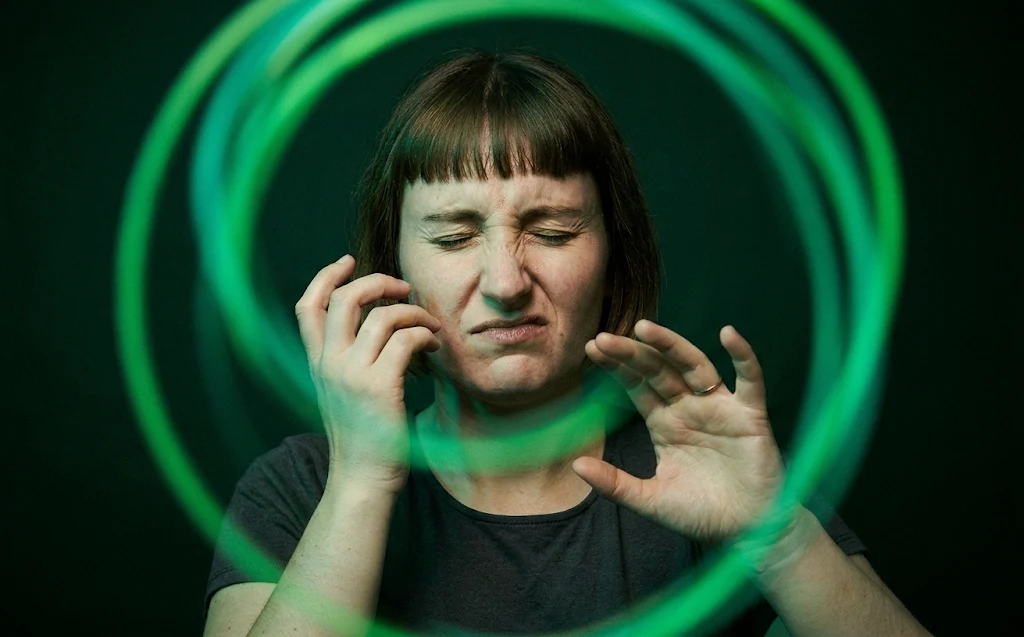
- Motor tics: Involuntary movements such as eye blinking, grimacing or head jerking.
- Vocal tics: Sudden exclamations, throat clearing or repeating words.
- Comorbidities: Frequent occurrence of accompanying conditions such as ADHD, obsessive-compulsive disorder or sleep disorders.
Standard treatments include behavioural therapy (e.g. habit reversal training) and medicines such as antipsychotics. Not all patients respond sufficiently to them, or they suffer side effects such as tiredness, weight gain or emotional blunting.
🌿 Can cannabis help with Tourette’s?
A medically supervised course of treatment aims to stabilise tic intensity and quality of life. Cannabis for Tourette’s can offer support here.
The endocannabinoid system is significantly involved in controlling movement in the brain (particularly in the basal ganglia). Active substances such as THC can bind to the receptors there, which can help to:
- Reduce tics: THC can dampen overexcitability in the affected areas of the brain and so modulate the frequency and strength of tics.
- Release inner tension: Many people affected feel a compelling premonitory urge before a tic, which can be eased by the relaxing effect of cannabis.
- Relieve accompanying symptoms: The sleep-promoting and calming component can bring relief with associated compulsions or states of restlessness.
Here at Bloomwell you can check whether you can become a cannabis patient, so that your treatment for Tourette’s is supervised by a doctor. [Check your suitability now & become a patient]
🧪 CBD and THC for Tourette’s
In professional treatment, the targeted ratio of the active substances plays a central role. While CBD for Tourette’s can support symptoms as a complementary, calming factor for the nervous system, the therapeutic management of THC for Tourette’s is at the centre of medical supervision because of its direct effect on tic control.
It is particularly important to recognise that the THC dose must be tailored precisely to your individual symptoms. As choosing which cannabis is best suited for Tourette’s requires a high level of medical expertise, continuous supervision by a specialist doctor is the safest way to reach the treatment goals you set together.
🎓 Studies on cannabis for Tourette’s
The evidence on cannabis for Tourette’s has developed in recent years:
- CANNA-TICS study (2022/2023): This large-scale, controlled study, led by Hannover Medical School, examined the efficacy of THC-containing medicines in Tourette’s. The results showed a significant reduction in tics compared with the control group in many participants. It is particularly worth highlighting that patients’ quality of life rose measurably with the treatment. ⁴
- Behavioural Neurology (Müller-Vahl): The pioneering work of Prof. Dr Kirsten Müller-Vahl, one of the world’s leading experts on Tourette’s, has shown for years that the endocannabinoid system is a promising therapeutic target. Her research shows that THC can effectively dampen overactivity in the basal ganglia – the “control centre” for movement. ⁵
Newer randomised studies on nabiximols (THC/CBD extract) also point to clinically relevant effects.
At the same time: The evidence is still limited and larger long-term studies are needed. A treatment decision is therefore always made individually after weighing up benefits and risks.
💬 Experiences with cannabis for Tourette’s
Many patients report the following under controlled treatment:
- Reduced motor tics: An easing of involuntary movements in the face, neck or limbs.
- Fewer vocal tics: A decrease in uncontrolled sounds or utterances.
- Better social participation: More confidence in dealing with other people and less embarrassment in public.
- More self-control in everyday life: A greater sense of mastery over one’s own body.
In the experiences with cannabis for Tourette’s, it is particularly often described that distressing “tic peaks” are flattened out. Phases of intense tic activity therefore often occur for shorter periods or less intensely, which makes everyday life at school, university or work much easier.
Use and dosing for Tourette’s
For treatment to succeed, an individual dose of medical cannabis is essential. As THC-containing flowers or extracts can work very differently, consulting your doctor is the most important factor in ensuring the best possible tolerability and safety in everyday life.
Side effects and risks
Like any drug treatment, medical cannabis can cause side effects. As every body reacts individually, assessment of these effects by a specialist doctor is a fixed part of any treatment.
Possible effects:
- Dry mouth
- Tiredness
- Increased appetite
- Temporary impairment of concentration
- Dizziness during the adjustment phase
In rare cases, restlessness or mood changes can occur. To minimise the risk of such reactions, the dose is always built up gradually and under close supervision by your doctor.
The effects on fitness to drive and general suitability for everyday activities are highly individual and are discussed in detail by your doctor as part of treatment. This ensures that the benefits of tic reduction are in line with your safety in everyday life.
❓FAQ on cannabis for Tourette’s
Can medical cannabis help with Tourette’s treatment?
Yes, it is often considered as an option when conventional medicines cause too many side effects or do not bring enough relief. The focus here is on reducing tics and tension.
Which cannabis is suitable for treating Tourette’s?
This is decided individually as part of the medical history. The choice of product and the THC dose for Tourette’s depend heavily on the intensity of the tics and any accompanying conditions.
Cannabinoid therapy at a glance
- Targeted tic reduction: Treatment with cannabis for Tourette’s acts directly on the basal ganglia in the brain. By modulating the endocannabinoid system, the frequency and intensity of motor and vocal tics can be reduced significantly.
- Relief of accompanying symptoms: Alongside tic control, use often helps to release the frequently distressing inner tension (premonitory urge) and to ease associated complaints such as sleep disorders or restlessness.
- Alternative in treatment resistance: If conventional medicines (e.g. antipsychotics) are not enough or cause too many side effects, medical cannabis – in particular THC for Tourette’s – offers a clinically studied option for a more self-determined everyday life.
Sources:
¹ AWMF: S3 guideline on tics (in German) https://register.awmf.org/assets/guidelines/028-007k_S3_Zwangsstoerungen_Kindes-_und_Jugendalter_2021-06.pdf
² Serag, I., Elsakka, M. M., Moawad, M. H. E. D., Ali, H. T., Sarhan, K., Shayeb, S., Nadim, I., & Abouzid, M. (2024).: Efficacy of cannabis-based medicine in the treatment of Tourette syndrome: a systematic review and meta-analysis. European journal of clinical pharmacology, 80(10), 1483–1493. https://doi.org/10.1007/s00228-024-03710-9
³ Müller-Vahl K. R. (2013).: Treatment of Tourette syndrome with cannabinoids. Behavioural neurology, 27(1), 119–124. https://doi.org/10.3233/BEN-120276
⁴ Müller-Vahl, K. R., Pisarenko, A., Szejko, N., Haas, M., Fremer, C., Jakubovski, E., Musil, R., Münchau, A., Neuner, I., Huys, D., van Elst, L. T., Schröder, C., Ringlstetter, R., Koch, A., Jenz, E. B., & Großhennig, A. (2023). CANNA-TICS: Efficacy and safety of oral treatment with nabiximols in adults with chronic tic disorders - Results of a prospective, multicenter, randomized, double-blind, placebo controlled, phase IIIb superiority study. Psychiatry research, 323, 115135. https://doi.org/10.1016/j.psychres.2023.115135
⁵ Szejko, N., Saramak, K., Lombroso, A., & Müller-Vahl, K. (2022). Cannabis-based medicine in treatment of patients with Gilles de la Tourette syndrome. Neurologia i neurochirurgia polska, 56(1), 28–38. https://doi.org/10.5603/PJNNS.a2021.0081
Vom Arzt verschriebenes und Apotheker hergestelltes medizinisches Cannabis ist ein verschreibungspflichtiges Arzneimittel.
Wie jedes Medikament kann jedoch auch Cannabis Nebenwirkungen und Risiken mit sich bringen, darunter Müdigkeit, Schwindel, Konzentrationsstörungen oder Wechselwirkungen mit anderen Medikamenten. Die Wirkung kann individuell unterschiedlich ausfallen.Die Anwendung sollte ausschließlich nach ärztlicher Beratung und unter medizinischer Begleitung erfolgen. Medizinisches Cannabis ersetzt keine medizinisch notwendige Standardtherapie. Änderungen oder das Absetzen bestehender Medikamente sollten niemals eigenständig vorgenommen werden.
Die Inhalte dieser Website dienen ausschließlich der allgemeinen Information und ersetzen keine individuelle medizinische Beratung, Diagnose oder Behandlung. Bei gesundheitlichen Beschwerden oder Fragen zur Therapie wenden Sie sich bitte an Ihre behandelnde Ärztin oder Ihren behandelnden Arzt.